Field Notes from NACAS South 2026: What Higher Ed Dining Is Telling Us About the Future of Institutional Meals

By Michelle Saletan, Institutional Support Manager, Balanced
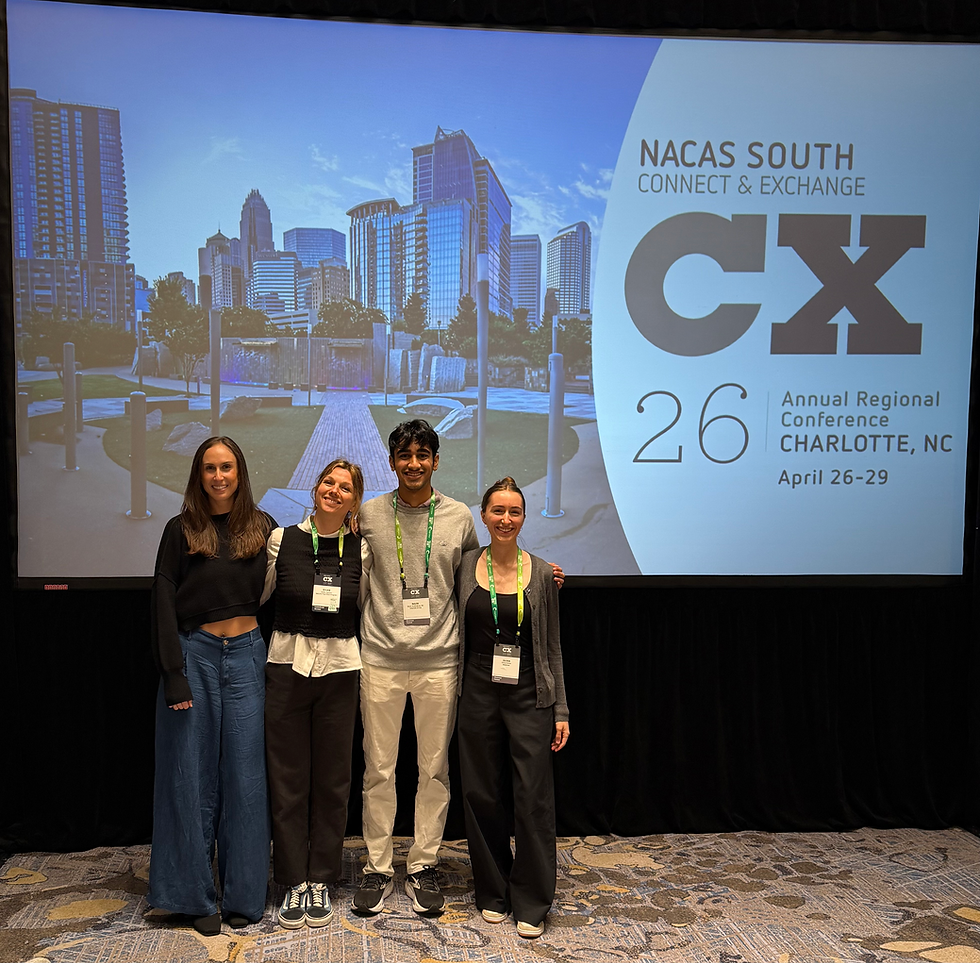
The NACAS South CX conference is not a room Balanced has historically been in. NACAS, the National Association of College Auxiliary Services, brings together the leaders who run campus dining, retail, housing operations, and business services across higher education. Our work at Balanced lives in K–12 school cafeterias. So when Sid Mehta, founder of Greenworks Inc. and a leader within NACAS NextGen
Dining, invited us to Charlotte for the South region’s annual conference; the question wasn’t whether to go. It was what we could learn and where Balanced might naturally fit in conversations that are already underway.

Olivia Rother and I spent four days in late April listening, asking questions, and trading notes with dining directors, auxiliary services leaders, and business partners from across the South. Here’s what we took away.
Plant-rich strategy is moving from values to operations
The first session we attended on Sunday was titled “Beef prices are up 40% — now what?” That framing tells you something. The panel, including LSU’s Margot Carroll, Conterra’s Jared Ceja, the University of Houston’s DeNesha Allen, and Claudia Lifton from the Plant Futures Initiative, wasn’t there to make the ethical or environmental case for plant-rich menus. They were there to make the operational and financial one.
What we heard, in essence: when commodity protein prices spike the way they did this year, dining programs that have already built fluency with plant proteins absorb the shock. Programs that haven’t are squeezed. Per-gram protein cost comparisons, repeatable recipes, and student-tested menu development, the same toolkit Balanced has been building with K–12 nutrition services directors, are showing up in higher ed as risk management infrastructure.

That theme carried through to Tuesday, when Liz Clark-Elizondo and Valentina Cordero from Humane World for Animals walked through their FRESH framework: Flavorful, Relevant, Economical, Sustainable, and Healthful. The framework itself is useful, but the more interesting signal was the room. Auxiliary services leaders are looking for practical lenses to make plant-forward menu decisions stick, not because they have to defend them, but because they’ve already decided to make them.

Local food systems are being built deliberately
The single most valuable conversation I had at NACAS was with Krisztian Varsa, Farms Fund Director at The Conservation Fund. Krisztian presented Monday alongside NC State’s Keith Smith, Emory’s Michelle Reuter (Bon Appétit Management Company), and Upgrade Dining’s Navin Durbhakula in a session on how Southern institutions are translating plant-forward, locally sourced commitments into operational reality.
What the Farms Fund is doing is genuinely model-worthy. They help young farmers access land, get crops planted and harvested, and supply that produce directly to colleges and universities, and then they support those farmers in scaling operations until the land can be sold back to the farmer on sustainable terms. It’s a closed loop: new farmers gain a foothold, regional food systems strengthen, and institutions get fresh, local produce they can actually plan menus around.
For K–12 nutrition programs working on farm-to-school sourcing, this is a model worth studying! The same supply infrastructure that feeds a university dining hall can, and in many regions, already does, feed the local school district. The operators are often shared. The growers definitely are.
Dining is being designed as wellness infrastructure
Brian Johnson from Tulane, alongside Hanbury’s Matthew Lee and Sarah Bannon, made a case I keep thinking about: campus dining and housing aren’t amenities. They’re wellness infrastructure. Their session framed student wellness through a People-Place-Purpose lens and used Tulane as a case study for how dining, housing, student affairs, and design teams collaborate to build environments that reduce loneliness and support belonging.
The broader takeaway, across multiple sessions and side conversations: higher ed has stopped treating dining halls as places where students refuel between classes. They’re being designed as the places where students meet each other. Where community forms. Where mental health is supported through the simple architecture of shared meals.
This is not a foreign idea in K–12. Cafeteria culture shapes how children develop relationships with food, with each other, and with the institutions feeding them, and the choices schools make about what they serve and how they serve it carry the same wellness weight. The scale is different. The principle is identical.
A note on partnership
One session worth flagging separately: Olivia attended a workshop led by Elon’s Caroline Ryan and City of Hospitality’s Todd Tekiele on practicing the partnership conversations that shape campus-business partner relationships. The format put institutional leaders and business partners into roleplays, including the genuinely uncomfortable scenario of a partner announcing a price increase.
What Olivia took from the room: cost is consistently named as the friction point between campus dining leaders and the partners trying to support them. That’s useful intelligence for us! Balanced offers institutional support, menu development, training, and communications at no cost to the partners we work with. In a sector navigating commodity volatility and tight margins, that’s a positioning we should be more direct about naming.
What we’re bringing back
We came to Charlotte to explore. What we found is that the conversations higher ed dining is having right now about plant-rich strategy as risk management, about local sourcing as infrastructure, about dining as wellness are the conversations Balanced has been part of in K–12 for years.

One thing that struck both Olivia and me throughout the week: the flexibility higher ed dining teams have to experiment, partner, and build is real.
Campus dining programs are launching pilots, formalizing relationships with local growers, redesigning physical spaces, and reshaping menus in ways that K–12 nutrition directors, operating under tighter federal reimbursement structures, stricter procurement rules, and thinner margins, often can't move on as quickly.
That's not a criticism of K–12. It's a reason to pay close attention to higher ed. The projects we heard about, the partnerships being formed, and the potential still being mapped out point to where institutional food is headed. And the more Balanced understands that trajectory, the better we can help K–12 partners prepare for what's coming next.
The work is the same work. Students grow up. The operators are often the same companies. And the case for building institutional food systems that put nutrition, sustainability, and student wellbeing at the center is being made, in every room we sat in, by leaders who already believe it.
Thanks to Sid Mehta, Sylke Jasper, NextGen Dining, Greenworks Inc., and the NACAS South community for the invitation.
Frequently Asked Questions
What is the NACAS South CX conference?
NACAS South CX is the annual regional conference of the National Association of College Auxiliary Services South Region, covering 12 U.S. states and Puerto Rico. It convenes campus dining directors, auxiliary services leaders, and business partners for educational sessions, networking, and an exhibit hall focused on higher education campus operations. The 2026 conference was held April 26–29 in Charlotte, North Carolina.
Why did Balanced attend NACAS South 2026?
Balanced attended NACAS South 2026 at the invitation of Sid Mehta, founder of Greenworks Inc. and a leader within NACAS NextGen Dining. The visit was an opportunity to connect with higher education dining leaders, learn how campuses are expanding plant-based and locally-sourced menus, and explore where Balanced’s institutional support model, currently focused on K–12 school meals, might naturally complement higher education food service work.
What is NACAS NextGen Dining?
NACAS NextGen Dining is a program within the National Association of College Auxiliary Services focused on advancing plant-rich, sustainable, and student-centered dining approaches across higher education campuses. It includes a Plant-Rich Program designed to help institutions move from aspiration to implementation in their dining operations.
How does The Conservation Fund’s Farms Fund support college and university dining?
The Conservation Fund’s Farms Fund supports young farmers by helping them access farmland, get crops planted and harvested, and supply produce directly to colleges, universities, and other institutional buyers. The Fund also helps farmers scale their operations until the land can be sold back to them on sustainable terms, creating a closed loop that supports new farmers, strengthens regional food systems, and gives institutions a reliable source of fresh local produce.
What is the FRESH framework for campus dining?
The FRESH framework, developed by Humane World for Animals, is a five-part lens for campus dining menu decisions: Flavorful, Relevant, Economical, Sustainable, and Healthful. It helps dining teams design dishes students return to, keep menus aligned with student preferences, make cost-effective ingredient choices, advance sustainability through default shifts rather than system overhauls, and support healthful eating patterns students actually embrace.


